You send the text and then watch your phone.
Are you mad at me?
Your partner replies, "No, of course not." For a few minutes you feel better. Then you start rereading the message. Was that a short answer? Did they sound annoyed? Maybe you should ask again, just to be sure.
If that sounds familiar, you're not alone. Reassurance seeking is one of the most common ways anxiety keeps itself going, and it often hides in plain sight because it looks so reasonable.
Reassurance Is Normal. Until It Isn't.
Everyone looks for reassurance sometimes. You ask a friend whether your outfit works for an interview. You check with a coworker before sending an important email. You tell your partner you're nervous about a family dinner and they say it'll be fine.
That's healthy. People are social, and leaning on others is part of how we handle stress.
Reassurance becomes a problem when it stops being occasional and starts being necessary. A few signs it may have crossed that line:
- You ask the same question more than once, even after you got a clear answer.
- The relief fades quickly, sometimes within minutes.
- You feel like you can't move forward until someone else confirms you're okay.
- You search online, replay conversations, or check your body repeatedly looking for certainty.
- The people around you seem tired of answering.
At that point reassurance isn't really about information anymore. You already have the information. What you're chasing is the feeling of certainty.
What Triggers the Urge
Reassurance seeking usually starts with uncertainty. Not danger, just not knowing.
Did I lock the door? Does my friend still like me? Is this headache something serious? Did I make the wrong career choice?
For many people with anxiety, uncertainty itself feels threatening. Your brain treats an unanswered question like an alarm that needs to be shut off right now. Asking for reassurance becomes the fastest way to quiet that alarm.
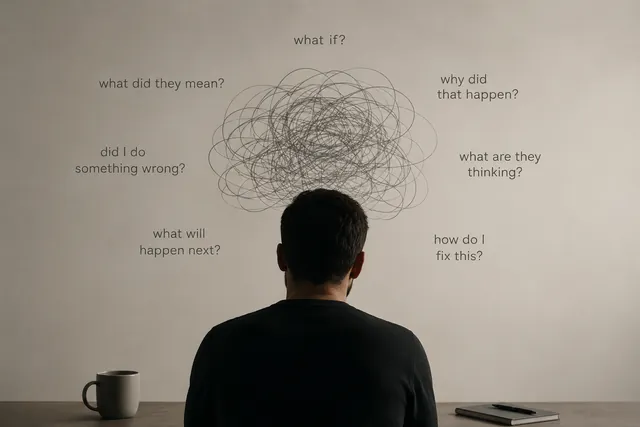
This is closely tied to how anxiety shows up as overthinking. The mind keeps circling the question, looking for an answer that feels final enough to finally let go.
The Reassurance Cycle
The pattern tends to look like this:
Doubt → Anxiety → Reassurance → Temporary relief → Renewed doubt
Here's why it's so sticky.
When you get reassurance, your anxiety drops. That drop feels good, and your brain remembers it. Psychologists call this negative reinforcement: a behavior gets stronger because it takes away something unpleasant. The relief rewards the checking, so the next time you feel uncertain, the urge to check shows up faster and stronger.
But the relief doesn't last, because the reassurance never actually resolved the uncertainty. Nobody can promise you that your partner will never be upset, that you'll never get sick, or that a decision will work out perfectly. So the doubt comes back, often with a new angle. Yes, but what if...
It works a lot like the anxiety-avoidance cycle. Reassurance is a way of avoiding the discomfort of not knowing. It helps right now and keeps the fear in place over time.
How Reassurance Undermines Self-Confidence
This is the part people often don't see.
Every time you hand a question to someone else to answer, you send yourself a quiet message: I can't trust my own judgment here.
Do that once and it means nothing. Do it dozens of times a week and it starts shaping how you see yourself. You may begin to feel that other people know better than you do about your own relationships, your health, or your choices. Your confidence starts depending on outside approval, which means it can disappear the moment someone hesitates or doesn't respond.
Confidence is built partly through experience. You make a call, live with it, and discover you could handle what happened. Compulsive reassurance skips that step. You never get to find out what you're capable of, because someone else is always carrying the uncertainty for you.
If this resonates, you may also find it useful to read about how to build self-confidence in a way that doesn't depend on other people's approval.
Support vs. Compulsive Reassurance
None of this means you should stop talking to people or handle everything alone. Support matters.
The difference is in the function.
Support helps you face something. You talk through a hard decision, get a different perspective, feel less alone, and then you make the choice yourself.
Compulsive reassurance helps you escape something. You're not looking for perspective, you're looking for a guarantee. And you usually need it again soon.
A helpful question to ask yourself: Am I trying to understand this better, or am I trying to make the uncomfortable feeling go away?
What This Looks Like in Real Life
Relationships
You ask your partner if they still love you. You check whether a friend's delayed reply means something is wrong. You reread texts looking for hidden meaning. Over time, relationships can start to feel like something you need to constantly monitor, and the people close to you may feel pressure to keep proving themselves.
Decisions
You can't choose a restaurant, an apartment, or a job offer without polling five people. You research for hours, then ask someone else what they'd do. Even after choosing, you keep asking if you made the right call. Decisions start to feel dangerous because you've learned to believe you can't make them alone.
Health Anxiety
You notice a sensation in your body and search it online. You ask a family member if it looks normal. You check the spot again later. You might book appointments repeatedly even after being told everything looks fine.
One important note here. Reducing reassurance seeking does not mean ignoring real medical concerns. If you have new, worsening, or unexplained symptoms, see a doctor and follow their guidance. The pattern worth working on is the repeated checking that continues after you've already gotten appropriate care and a clear answer.
How to Start Breaking the Cycle
You don't have to stop all at once. Small, steady changes work better than trying to force the urges away.
1. Notice the urge
Start by simply catching it. I want to ask again. I want to search this. I want to check. Naming the urge creates a little space between the feeling and the action.
2. Delay the check
Instead of saying no to reassurance forever, try saying "not yet." Wait ten minutes. Then try thirty. Often the urge peaks and then fades on its own. Each time you wait, you're showing yourself that the discomfort is survivable.
3. Practice tolerating uncertainty
This is the heart of it. Anxiety wants certainty, and life rarely gives it. Try telling yourself something honest like, Maybe everything is fine, maybe it isn't. I don't know right now, and I can live with not knowing.
It will feel uncomfortable at first. That discomfort is the work. This is similar to the idea behind why facing your fears reduces anxiety: the more you allow the feeling, the less power it has.
4. Make small decisions on your own
Pick something low stakes. Order lunch without asking anyone. Send an email without having it checked. Choose a movie and stick with it. Small decisions rebuild trust in your own judgment, one rep at a time.
5. Build confidence in coping, not certainty
The goal isn't to become sure about everything. That's not possible for anyone. The goal is to become confident that you can handle things even when you're unsure.
That kind of confidence is much sturdier. It doesn't need anyone else to sign off on it.
6. Let people support you differently
If loved ones often reassure you, you can ask them to help in a new way. Instead of answering the same question again, they might say, "I know this feels hard. What do you think?" That keeps the connection while handing the question back to you.
Getting Support With Reassurance Seeking
Reassurance seeking can feel automatic, especially if it's been part of how you cope for years. Working with someone can make it easier to spot the patterns and practice new responses in a structured, gradual way.
In my anxiety coaching work, I use CBT-informed and exposure-based approaches to help people notice their reassurance loops, sit with uncertainty, and build real trust in their own judgment. I'm a coach, not a therapist, and if you need clinical treatment I'll encourage you to seek it.
If you're tired of needing someone else to tell you you're okay, I'd be glad to talk. Book a free consultation and we can look at what's keeping the cycle going and what a first step might look like for you.