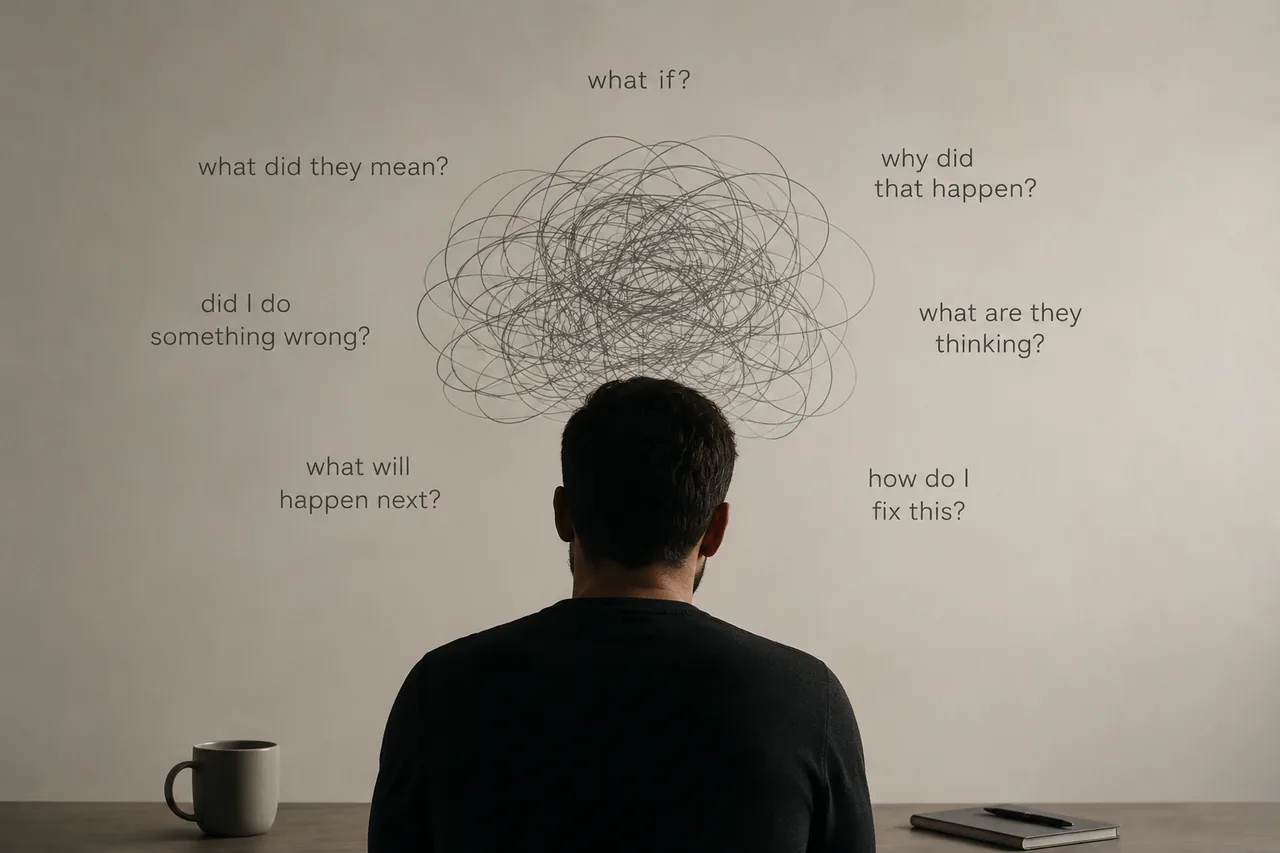
One of the problems with overthinking is that it usually doesn't feel like overthinking when you're doing it.
It feels like you're trying to figure something out.
Why did they say that? Did I make the right decision? What if this feeling means something is wrong? Should I send another text? Maybe I need to think through this one more time before I decide.
From your perspective, the subject keeps changing. From mine, the way you're responding to it might look very familiar.
That's something I pay close attention to as an anxiety coach.
The Subject Changes, but the Process Often Stays the Same
You might spend one week worrying about your relationship and the next worrying about work.
Then it's your health.
Then it's a decision you have to make.
These can all be legitimate things to think about. I'm not going to tell someone that every concern they have is anxiety or that they should stop thinking about anything difficult.
What interests me is what happens after the concern shows up.
Do you think about it until you feel certain?
Do you keep going back over information you already have?
Do you ask other people what they think, feel better for a little while, and then find another reason their answer might be wrong?
Do you make a decision and then immediately start questioning the decision?
That's the part you may have a hard time seeing when you're in it.
Overthinking Usually Has a Purpose
Most people aren't sitting around thinking excessively because they enjoy it. They're trying to accomplish something.
A lot of the time, they're trying to feel certain.
You want to know that your relationship is okay.
You want to know that you didn't make a mistake.
You want to know that someone isn't upset with you.
You want to know that the physical sensation you're experiencing isn't dangerous.
You want to know you're making the right choice.
The problem is that there are plenty of situations where you can't know for sure.
So what happens?
You think more.
Maybe another 20 minutes of analyzing will do it. Maybe another Google search. Maybe you should ask someone else what they think. Maybe you need to replay the conversation again because there was one part you didn't consider.
You get an answer, but the relief doesn't last.
That's important.
I Pay Attention to the Question Underneath the Question
Someone might ask me, "Do you think she sounded annoyed in that text?"
We can talk about the text. Maybe she did sound annoyed. Maybe she didn't.
But I'm also interested in why figuring that out feels so important.
What would it mean if she was annoyed?
What are you afraid happens next?
And what would happen if we simply couldn't determine what she meant?
Those questions often tell me more than analyzing the text itself.
Maybe you're afraid of rejection.
Maybe you think you did something wrong.
Maybe you're worried that conflict means the relationship is in trouble.
Or maybe you have a hard time allowing another person to be unhappy with you.
Now we have something useful to work with.
Anxiety Can Ask the Same Question in Ten Different Ways
This is something I see all the time.
You ask your partner if everything is okay.
They say yes.
An hour later, they seem quieter than usual, so you ask if they're sure.
They say they're fine.
Later that night, they don't respond to a text as quickly as usual. Now you're wondering whether they're pulling away.
Those sound like different concerns.
But you may really be asking the same question repeatedly:
Are we okay?
The same thing happens with work.
"Do you think the interview went well?"
"Was my answer to that question bad?"
"Why haven't they emailed me yet?"
"Would they have said that if they weren't interested?"
"Do you think I'll get the job?"
Each question feels new because there's a new detail attached to it.
But I may hear the same request underneath all of them: Tell me that this is going to work out.
That's much easier for me to see because I'm not experiencing the anxiety with you.
Sometimes You're Trying to Think Your Way Out of a Feeling
This is another big one.
You feel anxious, so you start thinking about why you're anxious.
That can be useful.
Understanding yourself matters. I spend a lot of time helping clients understand what's behind what they're experiencing.
But there comes a point where understanding turns into trying to make the feeling disappear.
You think, "If I can figure out exactly why I feel this way, maybe I won't feel this way anymore."
So you keep going.
Eventually, there may be nothing new to understand. You're still thinking because you're uncomfortable and your brain has learned that thinking feels like doing something about the discomfort.
At that point, more insight isn't necessarily what you need.
Overthinking Can Sound Very Rational
This is especially relevant for smart people.
You can have very good reasons for every question you're asking.
You can explain why this situation really does require more thought. You can find exceptions to every reassuring answer. You can identify the one variable nobody has considered yet.
And you may be completely right that uncertainty remains.
That's actually the point.
The problem isn't always that your thinking is irrational. Sometimes the problem is that you're trying to use thinking to reach a level of certainty that the situation can't give you.
There will always be another possibility.
If your requirement for moving forward is that you've ruled out every possibility, you're going to spend a lot of time in your head.
I Can See Repetition That Is Harder for You to See
When I work with someone regularly, I remember how they responded to other situations.
You might come into a session with something that feels completely different from what we discussed two weeks ago.
The details might be different.
But I might notice that you're doing the same thing.
You're trying to predict what someone will do.
You're replaying something that already happened.
You're asking for reassurance.
You're trying to make the perfect decision.
You're researching long after you have enough information.
You're trying to figure out how you're going to feel before you do something.
That's useful information.
I'm not saying the thing you're worried about doesn't matter. I'm pointing out that we've seen this response before.
This Is Why I Don't Want to Spend Every Session Reassuring You
I could tell someone that everything is probably going to be okay every time they're anxious.
They'd probably feel better.
For a while.
Then something else would happen and we'd have to do it again.
I don't think that's particularly helpful.
Sometimes I'll give you my opinion. Sometimes you genuinely need another perspective. But I also want to notice when you're asking me to remove uncertainty for you.
There are times when I might say:
I think we've already answered this.
Or:
I don't think you need more information. I think you want to feel certain.
That distinction matters.
If we keep answering every question anxiety produces, we can spend a lot of time solving problems that were already solved.
The Goal Is for You to Start Seeing It Too
Eventually, I want you to catch these things before I point them out.
You notice that you've asked three people the same question.
You realize you're reconsidering a decision you already made.
You catch yourself reading another article even though the last five told you basically the same thing.
You realize you've replayed the conversation ten times and haven't learned anything new.
You notice yourself asking, "But what if..." for the fifth time.
That's progress.
You don't have to stop the thought from showing up. You can recognize what you're doing and decide whether continuing to think about it is actually useful.
A simple question can help:
Do I need more information, or am I trying to feel more certain?
Those aren't the same thing.
You Don't Have to Stop Overthinking Completely
I don't think the goal should be to never overthink again.
That's unrealistic, and it can easily become another thing to worry about.
Sometimes you should think something through. Sometimes you should reconsider a decision. Sometimes your concern is telling you that something needs your attention.
The skill is learning when thinking is helping and when you've crossed into repeating the same process because you don't like how uncertain you feel.
That's where having another person involved can be useful.
I can hear the same question even when you've changed the wording. I can remember the last five situations where you responded the same way. I can point it out when you're trying to solve uncertainty instead of solving an actual problem.
Over time, you start seeing it too.
And once you can see it, you don't have to automatically follow it.